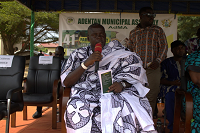
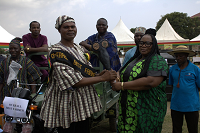
Rosemund Adjeoda has urged collective action to transform Ghana’s agricultural sector as she addressed the 41st Farmers’ Day celebration under the theme “Feed Ghana, Eat Ghana, Secure the Future.” Speaking to farmers, local officials and stakeholders, Ms Adjeoda outlined the objectives of the Feed Ghana Programme (FGP) and set out the municipal assembly’s commitments to boost domestic food production and reduce reliance on imports.
The FGP, she said, aims to modernise agriculture, increase production of staples, vegetables, livestock and industrial crops, supply raw materials to agro‑industries and create sustainable employment. The assembly, through the Department of Agriculture, pledged to mobilise small, medium and large‑scale farmers to adopt climate‑smart practices and to make full use of mechanisation centres, improved inputs and extension services provided under the programme.
Ms Adjeoda called on farmers, youth, women, agribusinesses, local institutions and financial partners to commit to the transformation, stressing that coordinated effort and discipline would help secure national food security, reduce food inflation and support agro‑industry.
Extension services and outreach
The Department of Agriculture currently employs 18 staff, including six Agricultural Extension Officers, and is awaiting national service personnel to bolster extension delivery. To date, 3,145 agricultural value‑chain actors — including farmers, fishers, processors, dealers and aggregators — have been reached with improved technologies and good agricultural practices.
Unlike the previous year, favourable weather during both major and minor seasons, together with timely fertiliser supplies under the Feed Ghana Programme, produced improved crop performance and higher yields, Ms Adjeoda reported.
Training and community work
In partnership with Holland Greentech, the department organised training for staff, farmers and community members on modern vegetable production techniques. The sessions covered integrated pest management, good agronomic practice and crop nutrition, and were designed to increase fresh‑vegetable consumption, promote sustainable livelihoods and strengthen food security in the municipality. The department also conducted 100 home and farm visits to support farmers directly.
Animal health and household sensitisation
As part of World Rabies Day activities, the department carried out rabies education in three junior high schools — Amrahia Adma School, Sowah Din Memorial and Adentan Community JHS — reaching 1,867 teachers and pupils. Vaccinations were administered to 400 poultry, 28 goats, 5 cats, 13 dogs, 2 sheep and 4 rabbits, while staff conducted passive surveillance during farm and household visits.
The department further sensitised 243 households on nutrient conservation and home gardening, including 63 households on organic compost and manure, 54 farmers on vegetable production, 15 women on backyard vegetable gardening and 44 farmers on improved housing for poultry and small ruminants.
Ms Adjeoda concluded by commending the municipality’s farmers for their dedication and urged renewed commitment to the Feed Ghana agenda, saying that, together, stakeholders could build a food‑secure future for all. She extended congratulations to the farmers and invoked a blessing for continued prosperity.
SOURCE: ISD,ADENTAN.